Table of Content


Neem Karoli Baba, also known as Neeb Karori Baba and lovingly called Maharaj-ji by his followers, was a Hindu guru and devotee of Hanuman. Born as Lakshman Narayan Sharma around 1900, he became known for his spiritual life and teachings.
One of the places most closely associated with his life is Kainchi Dham, a spiritual centre located in the Kumaon region of Uttarakhand. Established in 1964, Kainchi Dham has become an important pilgrimage destination and attracts visitors from different parts of India and around the world.
However, the growing popularity of Kainchi Dham is a relatively recent phenomenon for many people in Uttarakhand. For someone born and raised in the Garhwal division, the place was not necessarily a familiar name during childhood.
Who Was Neem Karoli Baba?
Neem Karoli Baba was a Hindu guru and devotee of Hanuman. He was born as Lakshman Narayan Sharma around 1900 in Akbarpur village in the Ambedkar Nagar district of Uttar Pradesh.
Early Life
He was born into a wealthy Brahmin family. His parents arranged his marriage when he was 11 years old. After leaving home, he became a wandering sadhu and travelled through Northern India.
At that time, he was known as Baba Lakshman Das, also spelled Laxman Das.
Later, at his father’s request, he returned home to live a settled married life. He had two sons and a daughter.
Kainchi Dham
The Origin of the Name Kainchi
One of the first things visitors notice about Kainchi Dham is its unusual name.
The word “Kainchi” (कैंची) translates to “scissors” in Hindi.
Why Is It Called Kainchi?
The name is associated with the distinctive topography of the valley of kumaon in Uttarkahand.
As you approach the ashram along the highway, the surrounding mountains curve and cross over one another, creating a sharp, scissor-like formation. The bends of the hills meet in a way that resembles the shape of scissors.
Because of this natural formation, the surrounding local area and village stretch were historically known as Kainchi, even before Neem Karoli Baba established the ashram there in 1964.
Kainchi Dham and Neem Karoli Baba
Kainchi Dham was established in 1964 with a Hanuman ji temple. Neem Karoli Baba spent the last decade of his life at Kainchi Dham.
Two major ashrams became associated with him during his lifetime: Kainchi and Vrindavan.
Over time, more than 100 temples were constructed in his name.
My First Experience at Kainchi Dham
My personal connection with Kainchi Dham began while I was living in Bhimtal near Nainital for two years during my post-graduation.
A Wednesday Journey from Bhimtal
During my first semester, a close university friend asked me if I wanted to visit the ashram.
At the time, I did not have a particularly strong spiritual reason for going. I simply agreed to accompany my friend.
It was a Wednesday in November. Our university had half-day schedules on Wednesdays, and after having lunch together, my friend convinced me to make the short trip to Kainchi Dham.
From Bhimtal, Kainchi Dham is roughly 17–20 kilometres away.
We first took a shared cab from Bhimtal to Bhowali, covering approximately 11 kilometres. Once we reached Bhowali, we decided to walk the remaining 8–9 kilometres to the ashram.
Walking Through the Hills
This visit took place before Kainchi Dham gained its current level of mainstream attention.
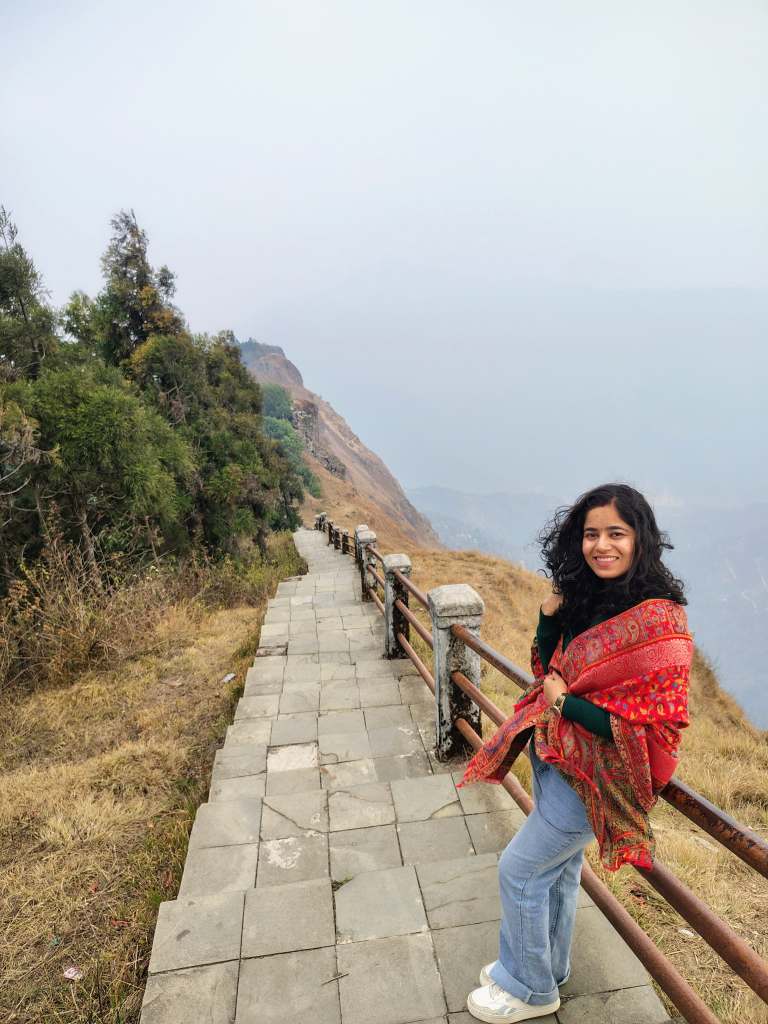
The road was relatively calm, and we walked almost completely alone along the mountain highway towards the Neem Karoli Baba Ashram.
Local Stories About Neem Karoli Baba
My friend was from the Kumaon region, and during the walk she shared memories from her family.
She told me that members of her family had physically met Neem Karoli Baba years earlier.
Other friends from nearby villages had also shared similar stories. They remembered how Baba ji would visit village homes, sit with families and eat meals with them when they were children.
The Gadhera
During our walk along the winding mountain road, we came across a natural hill stream.
Locally referred to in the Pahari dialect as a “gadhera”, the stream flowed between the hills.
We stopped there for photographs before continuing towards the valley floor and the ashram.
Arriving at Kainchi Dham
Eventually, the road opened up and the ashram came into view.
The temple complex was situated down near the river, and from our position higher up on the road, we could see the entire complex below.
Seeing the ashram from above was one of the most memorable parts of the journey.
We walked down to the temple complex and removed our shoes at the entrance.
Kainchi Dham: Then and Now
The atmosphere of Kainchi Dham during that first visit was very different from what visitors experience today.
Unrestricted Access
During our visit, almost the entire premises were open for pilgrims to explore, sit and reflect.
Today, the large number of visitors means that barricades, organised queues and restricted areas are used across different parts of the complex.
Calm and Silence
During that earlier visit, we were able to enter different corners of the ashram and sit quietly for an extended period.
The overall environment felt peaceful and undisturbed, surrounded by the hills and valley.
The Annual June 15 Bhandara
Every year on June 15, a large fair, commonly referred to as the Bhandara, is organised to commemorate the foundation day of Kainchi Dham.
Large Number of Devotees
Devotees and visitors from different regions travel to Kainchi Dham to attend the event.
Because of the large number of people arriving for the annual gathering, traffic management becomes an important part of the event.
Shuttle Services from Bhowali
The narrow mountain road can experience significant congestion during the event.
To manage the influx of vehicles, the temple committee and local administration organise dedicated shuttle services operating between Bhowali and the Neem Karoli Baba Ashram.
During peak seasons and the June 15 Bhandara, private vehicles travelling beyond Bhowali may also be regulated, requiring visitors to use the official shuttle services.
Kainchi Dham Travel Guide

For anyone planning a visit to Kainchi Dham and the surrounding Kumaon region, understanding the distances, routes and transport options can make the journey easier to plan.
| Origin / Hub | Distance to Kainchi Dham | Route / Connecting Highway |
|---|---|---|
| Bhowali | ~8–9 km | NH 109 |
| Bhimtal | ~17–20 km | Bhowali–Bhimtal Road to NH 109 |
| Nainital | ~18–20 km | Bhowali–Sanatorium Road / NH 109 |
| Kathgodam | ~37 km | NH 109 via Haldwani & Bhowali |
| Pantnagar Airport | ~71 km | NH 109 via Pantnagar, Haldwani & Bhowali |
| Almora | ~44 km | NH 109 |
| Dehradun | ~290 km | NH 7 / NH 34 to NH 109 |
| Delhi | ~340 km | NH 9 / NH 109 via Rampur & Haldwani |
Elevation and Geographical Setting
Kainchi Dham Elevation
The ashram is situated at approximately 1,400 metres (around 4,593 feet) above mean sea level.
Geographical Profile
Kainchi Dham is situated in a valley carved by a tributary of the Kosi River and is surrounded by pine-covered hills in the Nainital district of the Kumaon region.
How to Reach Kainchi Dham
Kainchi Dham can be reached by air, rail and road.
By Air
The nearest airport is Pantnagar Airport (PGH), approximately 71 kilometres from Kainchi Dham.
From Pantnagar Airport
Direct taxis, private cabs and pre-booked vehicles operate from Pantnagar towards Kainchi Dham via Haldwani and Bhowali.
By Rail
The nearest major railhead is Kathgodam Railway Station (KGM), approximately 37 kilometres from Kainchi Dham.
From Kathgodam Railway Station
Kathgodam is connected by direct trains with major Indian cities, including Delhi, Lucknow and Kolkata.
After reaching the railway station, visitors can find shared taxis, state transport buses operated by UTC and private vehicles.
By Road
Kainchi Dham is situated directly along National Highway 109 (NH 109), which connects Bhowali with Almora.
Bus and Taxi Connectivity
Regular Uttarakhand Transport Corporation (UTC) buses and private shared taxis operate from Haldwani, Kathgodam, Nainital and Bhowali towards Kainchi Dham.
Road Restrictions During Peak Periods
During peak tourist periods and the annual June 15 Bhandara, private vehicular movement beyond Bhowali may be regulated.
In such situations, visitors may need to park or reach Bhowali and use the official shuttle services operating between Bhowali and Kainchi Dham.
The Death of Neem Karoli Baba
Neem Karoli Baba died at approximately 1:15 a.m. on 11 September 1973 in a hospital in Vrindavan after slipping into a diabetic coma.
Before his death, he had been travelling by night train towards Kainchi near Nainital from Agra, where he had visited a heart specialist because of chest pain.
His Final Journey
Neem Karoli Baba and his travelling companions got off the train at Mathura railway station after he began experiencing severe physical distress.
He was taken to a hospital, where he died.
His last words, repeated several times, were:
“Jaya Jagadish Hare” — “Hail to the Lord of the Universe.”
His samadhi, or shrine, was later built within the Vrindavan ashram complex.
The Legacy of Neem Karoli Baba
The influence of Neem Karoli Baba continued through his followers and organisations established around his teachings.
Ram Dass and Larry Brilliant
After returning to the United States, Ram Dass and Larry Brilliant founded the Seva Foundation, an international health organisation based in Berkeley, California.
Love Serve Remember Foundation
In the late 2000s, the Love Serve Remember Foundation was established to promote the teachings of Neem Karoli Baba.
NKB Divine Meditation Foundation
In 2024, his follower Rahul Verma founded the NKB Divine Meditation Foundation, which offers free guided meditation sessions based on the teachings of Neem Karoli Baba.
Kainchi Dham Today
Kainchi Dham has developed from a relatively quiet Himalayan ashram into a destination known to devotees and visitors from different parts of the world.
For those visiting today, the experience can be very different from the quieter atmosphere described in earlier visits. Large visitor numbers, organised queues, barricades and traffic-management arrangements have become part of the pilgrimage experience, particularly during busy periods.
Yet the story of Kainchi Dham remains closely connected with Neem Karoli Baba, his devotion to Hanuman and the ashram he established in this distinctive Himalayan valley.
Final Thought
Kainchi Dham is not simply a place associated with a famous spiritual figure. Its story is also connected with the landscape of the Kumaon hills, the local communities and the personal memories of people who experienced the ashram before it became widely known.
For visitors planning their journey, the location offers several access options through Pantnagar Airport, Kathgodam Railway Station and the road network connecting Bhowali, Nainital, Bhimtal and Almora.
And for those who have visited Kainchi Dham before its recent rise in popularity, memories of quiet roads, open spaces and peaceful moments inside the ashram provide a striking contrast to the crowds and organised arrangements seen today.
The Spirit of Uttarakhand
At Uttarakhandpedia, our aim is to showcase Uttarakhand beyond its popular tourist destinations. We want to share the state’s history, culture, traditions, spirituality, food, people, and the landscapes that make it unique, while bringing lesser-known stories and places to a wider audience. Through Uttarakhandpedia, we hope to help people discover, understand, and appreciate the many layers of Uttarakhand and its rich Himalayan heritage.


Leave a Reply