
Introduction
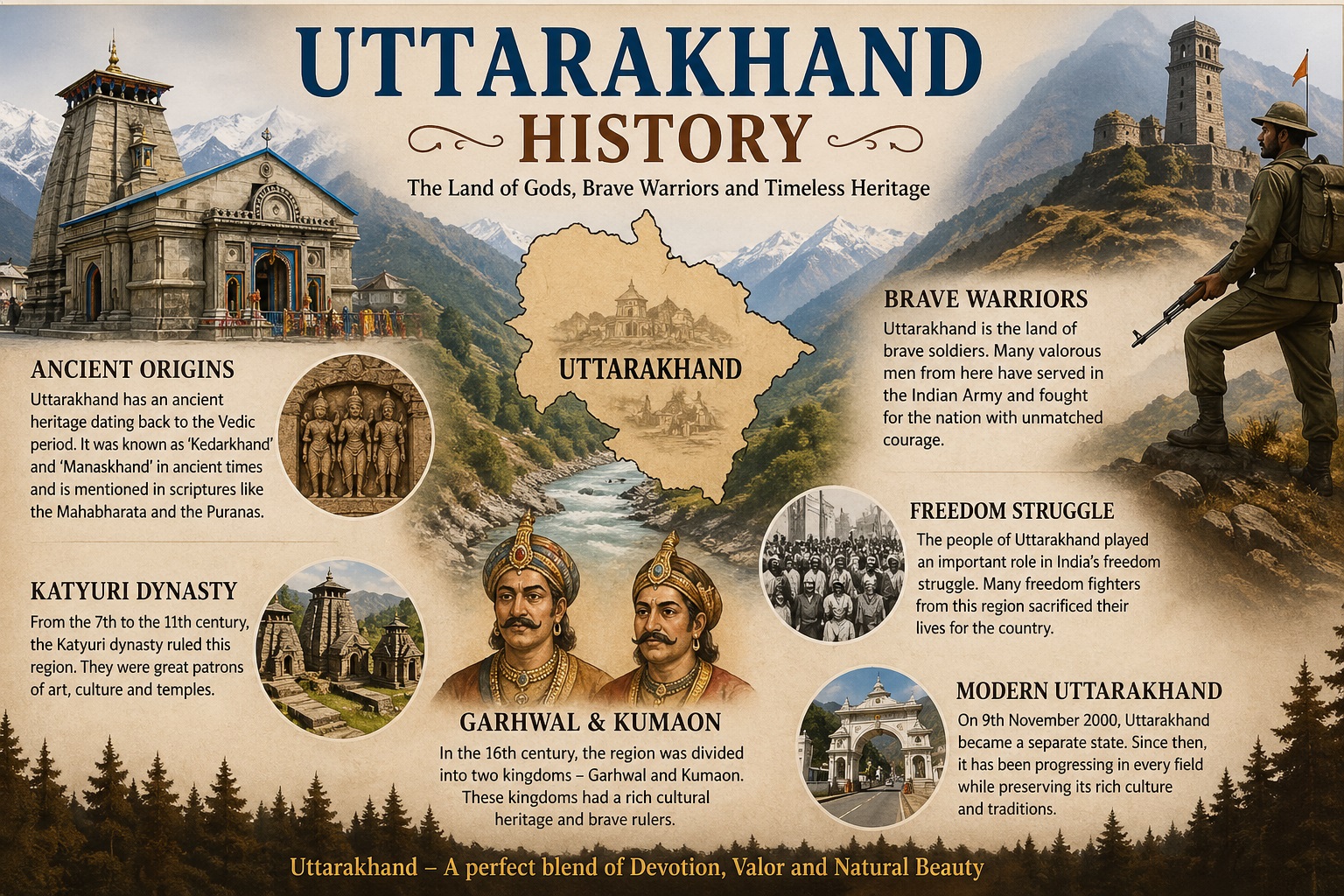
The history of Kumaon, Uttarakhand is etched into the stone temples of Jageshwar and the high ridges of Almora. This is the human journey of the “Lunar Dynasty” (Chandravanshi)—a lineage that transformed a small estate in Champawat into a Himalayan empire that stood for nearly a thousand years.
Table of Contents
1. The Arrival: Som Chand & The Legacy of Power in Uttarakhand
In the 10th century, as the ancient Katyuri Empire began to fade, a prince named Som Chand arrived from the plains of Jhansi on a pilgrimage. He found a region in transition. The last Katyuri king, Brahmadeo, faced a crisis of succession—he had a daughter but no male heir to protect his throne from local rebellions.
In a move of strategic trust, Brahmadeo married his daughter to Som Chand and granted him a small estate in Champawat. This union marked the birth of the Chand dynasty—a lineage that would define Kumaon for centuries.
Som Chand wasn’t just a ruler; he was a social architect. He realised that to govern the hills, he needed to listen to the people. He established a council of four local clans—the Boras, Karkis, Chaugans, and Phartyals—known as the Chaurasi. This early “human” version of the Panchayati Raj ensured that the local voice was heard within the walls of Rajmura Fort, creating a government built on local trust rather than force.
2. The Migration: From Champawat to Almora
As the kingdom expanded, Champawat became too small. Raja Bhishma Chand saw the strategic beauty of the Almora ridge, but he didn’t live to see his vision completed. It was Kalyan Chand (the 44th ruler) who officially moved the capital to Almora in the 1560s. He built the Lal Mandi palace, turning a quiet mountain ridge into the cultural and political heartbeat of the central Himalayas.
3. The Golden Era: Rudra Chand & the Mughal Connection
Rudra Chand (the 45th ruler) was a contemporary of the Mughal Emperor Akbar. A true scholar-king, he understood that Kumaon’s prosperity depended on its relationship with the plains. He travelled to the Mughal court, securing the rights to the fertile Terai (the fertile foothills) region. He used this wealth to build the city of Rudrapur and patronised the arts, making Kumaon a beacon of Sanskrit learning and temple architecture.
4. The Warrior King: Baz Bahadur Chand
If there is one figure who embodies Kumaon’s military peak, it is Baz Bahadur Chand (50th ruler). A protector of the high mountain passes, he led a campaign deep into Tibet to ensure that the pilgrimage to Kailash Mansarovar remained safe for his people. He is also the one who brought the worship of Golu Devta (the God of Justice) into the royal fold, building the famous temple at Ghorakhal.
5. The 7-Year Itch: Lakhmi Chand and the Garhwal Rivalry
No history of Kumaon is complete without the rivalry with Garhwal. Raja Lakhmi Chand was famously obsessed with defeating Srinagar. He attacked Garhwal, Uttarakhand seven times and was repelled seven times. When he finally achieved a minor victory on his eighth attempt, the celebrations in Kumaon were so massive they birthed the festival of Khatarua, which is still celebrated today with bonfires.
6. The Kingmaker: Harsh Dev Joshi
No history of the Chands is complete without the complex figure of Harsh Dev Joshi. He was not a king, but as the prime minister, he held the fate of the dynasty in his hands. During the late 1700s, when the Chand line was weakened by internal strife and palace intrigue, Harsh Dev became the “Earl of Warwick” of Kumaon. Faced with a crumbling state, he made the monumental decision to invite the Gorkhas of Nepal to stabilise the region—a gamble that would redefine Kumaoni history.
7. The Gorkha Era & the End of an Era
In 1790, the Gorkhas crossed the Kali River, defeating the last Chand King, Mahendra Chand, at the Battle of Havalbagh near Almora, Uttarakhand. This marked the start of the Gorkha period. While this era brought significant changes to the administrative structure, it was a time of immense pressure for the region. The Chand dynasty’s sovereign rule ended here, and in 1815, the British transition turned Kumaon into a province, closing the chapter on a millennium of Chand kings.
8. The Lineage Table (Chand Dynasty)
The Chand dynasty (Chand Wansh) was the prominent ruling family of the Kumaon region in Uttarakhand. While historical records for the early period vary among scholars, the lists provided by Sir Edwin T. Atkinson (in his Himalayan Gazetteer) and Dr Ajay Singh Rawat (in History of Uttarakhand) are the primary academic references.
| Ruler Name | Significant Notes & Achievements |
| Som Chand | Traditionally the founder is said to have come from Jhusi (near Prayagraj). |
| Atma Chand | Son of Som Chand. |
| Indra Chand | Credited with introducing silk production to Kumaon from China/Nepal. |
| Sansar Chand | |
| Hamira Chand | |
| Bina Chand | Often described as an incompetent ruler whose reign led to a brief Khas rule in Kumaon. |
| Thohar Chand | Cited by some as the 23rd ruler or the actual founder of the mediaeval dynasty. |
| Trilok Chand | A contemporary of Alauddin Khilji, he expanded the kingdom to the Bhimtal area. |
| Garuda Gyan Chand | The first Chand king to visit the Delhi Sultanate was Firoz Shah Tughlaq, who gave him the title “Garuda”. |
| Bharti Chand | Famous for a 12-year war against the Doti (Nepal) kings to gain independence. |
| Ratna Chand | Conducted the first land settlement (revenue records) in Kumaon. |
| Bhishma Chand | Planned the shift of the capital from Champawat to Almora; built Khagmarakot. |
| Kalyan Chand III | Formally established Almora as the capital in 1563. |
| Rudra Chand | A contemporary of Akbar’s, he founded Rudrapur and wrote Shyena Sastra. |
| Baz Bahadur Chand | Reached the peak of power; invaded Tibet and captured the Nanda Devi idol. |
| Mahendra Chand | The last ruler of the dynasty, defeated by the Gorkhas in the Battle of Havalbagh (1790). |
“The sun may have set on the Chand palaces of Almora, but their legacy still shines through the Aipan art on Kumaoni walls, the bells of the Jageshwar temples, and the resilient spirit of the people who call these mountains home.”
Conclusion: The Lasting Legacy of the Chand Kings
The saga of the Chand Dynasty is the story of Kumaon’s transition from a collection of scattered tribes into a cohesive, culturally rich kingdom. For over a millennium, these “Moon Kings” navigated the complexities of Himalayan geography and mountain warfare, leaving behind a legacy that is still etched into the landscape of Uttarakhand today.
Their contribution was not merely political; it was foundational. The administrative structures they built, the land systems they introduced, and the magnificent stone temples they commissioned—from Champawat to Almora—provided the bedrock for Kumaoni identity. While the dynasty eventually succumbed to internal strife and the Gorkha invasion in the late 18th century, their influence remains unvanquished. To walk through the ancient corridors of Kumaon’s temples is to walk through a history written by the Chands—a history of resilience, faith, and the enduring power of the mountains.

Leave a Reply