Introduction
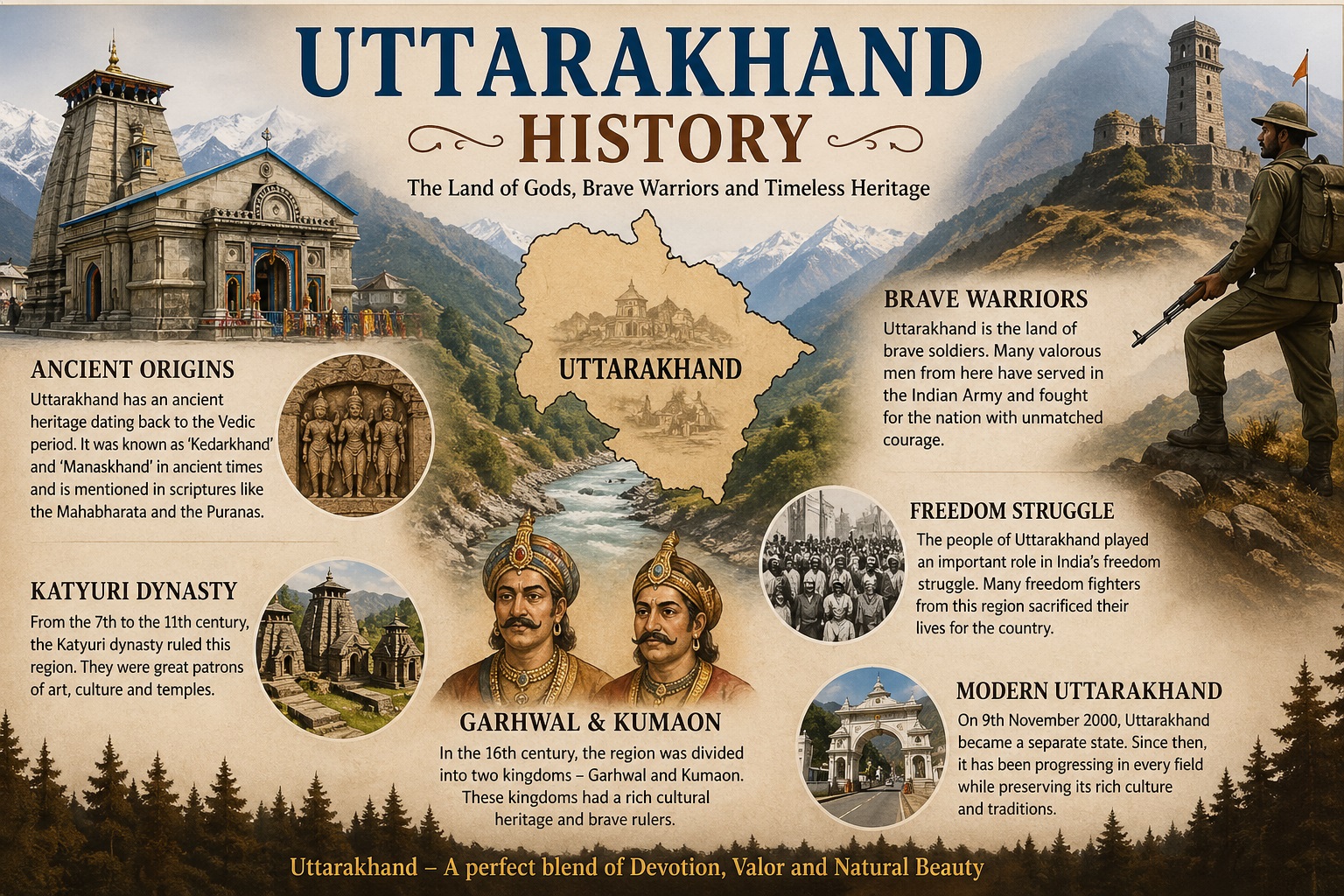
The story of Garhwal, Uttarakhand, isn’t just about dates and stone walls; it is a story of a family—the Panwars—who arrived as guests and stayed to become the soul of the mountains. From the high ridges of Chamoli to the submerged heart of old Tehri, here is how the “Land of Forts” came to be.
Table of Contents
1. The Traveler from Malwa to Uttarakhand: Kanak Pal
In the year 823 CE, a prince named Kanak Pal left the plains of Malwa (present-day Dhar, Madhya Pradesh) on a pilgrimage. He wasn’t looking for a kingdom but for Badrinath. When he reached Chandpur Garhi in Chamoli, he met the local chieftain, Raja Bhanu Pratap.At that time, the region was divided into 52 small, independent fortresses (Garhs), each governed by local chieftains (Ranas, Rais, or Thakurs). Kanak Pal met the ruler of Chandpur Garhi, Raja Bhanu Pratap, who had no male heir. Impressed by the prince, the king married his daughter to him and abdicated, handing over the throne of Chandpur Garhi to Kanak Pal. This fortress became the first seat of the Panwar dynasty that would last over 1,100 years.
2. The Great Unifier: Ajay Pal, the Ashoka of Garhwal
For centuries, the Panwars were just one of 52 “Garhs” (forts). That changed with Ajay Pal (the 37th ruler). He was the Ashoka of Garhwal. Driven by a vision of a unified land, he conquered or befriended all 51 other chieftains.Realising that Chandpur Garhi was too remote to manage his new empire, he moved the capital first to Devalgarh and then to Srinagar on the banks of the Alaknanda. He wasn’t just a conqueror; he was a devotee who established the administrative systems that defined the region for generations.
3. The Era of the “Shah” Title
For centuries, the rulers of Garhwal were known by the suffix “Pal” (meaning “protector” or “guardian”), a tradition that began with the founder, Kanak Pal.The shift to the title “Shah” happened in the late 16th century, specifically starting with Balbhadra Shah (43rd ruler; the first to adopt the “Shah” title to assert sovereignty). It wasn’t just a change in name; it was a political manoeuvre. By adopting the “Shah” title—a title commonly used by Mughal royalty and their high-ranking vassals—the Garhwali kings were essentially signalling to the powers in the plains (like the Mughals in Delhi) that they were an independent, sovereign kingdom and not just a collection of mountain forts. It was a declaration of equality and prestige.
4. The Golden Age: Mahipat Shah, Rani Karnavati, and Madho Singh
Under kings like Man Shah, the 44th ruler, who strengthened the kingdom through military defence, and the powerful Mahipat Shah (the 46th ruler), Srinagar became a hub of culture and bravery.
The “Nakti Rani”: Rani Karnavati
When Mahipat Shah passed away, his son Prithvi Shah was just a child. His widow, Rani Karnavati, took the reins as Queen Regent. In 1635, the Mughal Emperor Shah Jahan sent a massive army under Najabat Khan to conquer the “uncivilised” hills.Karnavati didn’t just defeat them; she humilitated them. Instead of killing the captured Mughal soldiers, she gave them a choice: die or lose your noses. They chose the latter and retreated in shame. To this day, history remembers her as Nakti Rani (the cut-nose queen)—a woman who proved that Himalayan grit was sharper than any Mughal sword.
The Architect of Life: Madho Singh Bhandari
Every great king needs a great General. Madho Singh Bhandari was Mahipat Shah’s right hand. While he won many battles, he is most loved for his “human” touch. Legend says he dreamt of bringing water to the dry village of Maletha. He spent years carving a tunnel through solid rock to divert a river. His sacrifice for his people made him a folk hero whose name is still sung in Jagars across Uttarakhand.
The kingdom felt invincible, protected by the mountains and the fierce loyalty of its people. But nature and neighbours had other plans.
5. The Gorkha Storm and the Fall of Pradyumna Shah
By the late 1700s, Garhwal was weakened by a massive earthquake and internal strife. The Gorkhas of Nepal saw an opening. In 1804, Raja Pradyumna Shah (54th king, the last king of unified Garhwal) sold his jewellery and even the throne’s silver to raise an army. He died a hero’s death at the Battle of Khurbura in Dehradun, marking the beginning of a dark decade known as Gorkhyani—a period of harsh military rule.
6. The Rebirth of Tehri: Sudarshan Shah
The royal line didn’t end. Pradyumna’s son, Sudarshan Shah (55th, re-established in Tehri, 1815). The year 1815 wasn’t just a celebration of the Gorkhas leaving; it was a cold realisation for the young King Sudarshan Shah. The British “help” came with a receipt. When the king couldn’t produce the 700,000 rupees demanded for military expenses, the British carved the map in two. They kept the fertile lands of Srinagar and Pauri for themselves, leaving the king to cross the river and start a new life in the rugged, undeveloped hills of Tehri. With no capital left, Sudarshan Shah stood at the confluence of the Bhagirathi and Bhilangna rivers. On December 28, 1815, he laid the foundation of Tehri. It was a humble beginning for a “human” king who had to rebuild a life from scratch.
7. The Modernizers of Tehri (The Later Kings)
56th . Bhawani Shah (r. 1859–1871)
The son of Sudarshan Shah, his reign was relatively short but focused on stabilising the new borders of the Tehri State after the turmoil of the partition.
57th . Pratap Shah (r. 1871–1886)
He was the first to realise that Tehri was getting crowded and hot in the summers. He founded the city of Pratap Nagar on a high ridge overlooking the valley. He is also credited with introducing the first English school in the state and formalising the police and judicial systems.
58th . Kirti Shah (r. 1886–1913)
A true scholar-king, Kirti Shah was educated at Mayo College. He was a visionary who brought electricity to Tehri and founded the city of Kirti Nagar (near Srinagar) to serve as a gateway to his kingdom. He was deeply respected by the British for his intellect and was given the title of “Companion of the Order of the Star of India”.
59th. Narendra Shah (r. 1913–1946)
Narendra Shah was the ultimate moderniser. He realised that the administration needed a cooler, more accessible location. In 1919, he founded Narendra Nagar on the ridge of Odathali. He built hospitals, improved roads, and established the high court.
60th . Manvendra Shah (r. 1946–1949)
The final reigning monarch. He saw the transition of India from British rule to independence. On August 1, 1949, he signed the merger agreement that integrated Tehri Garhwal into the Indian Union. He later served as a long-time Member of Parliament (MP) from Tehri.
8. The Fate of the Royal Haveli (Narendra Nagar)
The Narendra Nagar Haveli (The Palace) is one of the most stunning pieces of royal heritage left in Uttarakhand. It sits at an elevation of nearly 4,000 feet, offering a bird’s-eye view of the Doon Valley and Rishikesh.
- Current Status: Today, the majestic palace has been converted into a world-renowned luxury spa and destination resort known as Ananda in the Himalayas.
The “Human” Touch: While the interior is now a high-end wellness retreat, the royal family still maintains a private wing and continues to perform traditional ceremonies there, such as the Rajyabhishek (coronation) rituals and the annual Gaadu Ghada (sacred oil) ceremony for the opening of Badrinath.
9. The Lineage Table (Panwar Dynasty)
| No. | Ruler Name | Key Historical Milestone / Capital |
| 1 | Kanak Pal (823 CE) | Founder. Married Bhanu Pratap’s daughter (Chandpur Garhi). |
| 2-36 | (Early Rulers) | Consolidated local Garhs in the Chamoli region. |
| 37 | Ajay Pal | The Great Unifier. Moved capital to Devalgarh then Srinagar. |
| 38-42 | (Intermediate Rulers) | Stable rule in Srinagar; expansion of trade. |
| 43 | Balbhadra Shah | The First “Shah”. Adopted the title for regional prestige. |
| 44 | Man Shah | The Defender. Defeated 7 Kumaoni invasions. |
| 45 | Shyam Shah | Noted for his lavish court and relations with the Mughals. |
| 46 | Mahipat Shah | Garbh Bhanjan. Known as the Conqueror; height of military power. |
| – | Rani Karnavati | The Regent (Nakti Rani). Defeated Mughals while ruling for her son. |
| 47 | Prithvi Shah | Maintained the kingdom’s sovereignty against Aurangzeb. |
| 48 | Medini Shah | Noted for the Suleiman Shikoh (Mughal Prince) controversy. |
| 49 | Fateh Shah | Known for the “Battle of Bhangani” against Guru Gobind Singh. |
| 50 | Upendra Shah | Short reign during a period of rising regional tensions. |
| 51 | Pradip Shah | A long, peaceful reign before the decline began. |
| 52 | Lalit Shah | Defeated the Chands and placed his son on the Kumaon throne. |
| 53 | Jayakrit Shah | Faced internal rebellions and family strife. |
| 54 | Pradyumna Shah | The Martyr. Died at the Battle of Khurbura (1804). |
| 55 | Sudarshan Shah | The Rebuilder. Founded Old Tehri (1815) after the war debt. |
| 56 | Bhawani Shah | Stabilised the new borders of the Tehri Princely State. |
| 57 | Pratap Shah | Founded Pratap Nagar; introduced modern education. |
| 58 | Kirti Shah | Founded Kirti Nagar; brought electricity and science. |
| 59 | Narendra Shah | Founded Narendra Nagar; built the Modern Haveli (now Ananda). |
| 60 | Manvendra Shah | The Last King merged Tehri Garhwal with India in 1949. |
“From the ancient stone walls of Chamoli to the submerged heart of Old Tehri, and finally to the clouds of Narendra Nagar, the Panwar dynasty didn’t just rule Garhwal—they evolved with it. Today, while the waters of the Tehri Dam cover the old capital, the spirit of the ‘Shahs’ remains alive in the architecture of Narendra Nagar and the stories told in every Pahadi home.”
Conclusion: The Sovereign Spirit of Garhwal
The history of Garhwal is a testament to resilience and the pursuit of unity amidst the world’s highest peaks. From the early unification of the 52 Garhs (forts) by Kanakpal to the sophisticated administration of the Panwar Kings, Garhwal established an identity that was as unyielding as the Himalayas themselves. Unlike many contemporary kingdoms, the rulers of Garhwal successfully maintained a unique autonomy, fostering a golden age of Pahari art, culture, and architecture that defined the “Land of the Gods.”
Though the late 18th century brought the challenges of Gorkha expansion and subsequent British influence, the cultural foundation laid by the Garhwali kings remains the heartbeat of the region today. From the sacred traditions of the Char Dham to the vibrant heritage of the local people, the legacy of the Garhwal Kingdom is not just found in history books, but in the living spirit of the mountains. To understand Garhwal is to respect a legacy of independence and a deep-rooted devotion to the soil of Uttarakhand.



Leave a Reply